

In 2026, many seniors living on Social Security are navigating a difficult financial balance.
Inflation has eased in some areas, but healthcare, housing, insurance, and utilities continue to pressure fixed-income households. When your income doesn’t fluctuate, unexpected expenses feel heavier — and financial flexibility becomes essential.
A well-chosen credit card can provide that flexibility.
But not all credit cards are suitable for retirees. If you rely primarily on Social Security income, approval odds, fee structures, and penalty policies matter more than rewards points.
This guide explains which types of credit cards work best for seniors on Social Security, how to qualify responsibly, and when to choose a more conservative option instead.
Why Seniors on Social Security Face Different Credit Challenges
Credit card issuers evaluate risk using automated models. These models focus on:
- Income level
- Debt-to-income ratio
- Payment history
- Credit utilization
- Account age
For seniors, income may be stable but modest. Social Security is reliable — but lenders often see fixed income as limited growth potential.
At the same time, retirees may carry:
- Medical balances
- Reduced savings after market fluctuations
- Fewer active credit accounts
This combination can lower approval odds or reduce credit limits.
The solution is not chasing premium cards. It’s selecting cards aligned with fixed-income stability.
What to Look for in a Credit Card on Fixed Income
Before reviewing the three best card categories, let’s clarify what matters most.
No Annual Fee
Every recurring fee reduces purchasing power. On Social Security, predictability is essential.
An ideal card should not charge an annual fee — especially during rebuilding phases.
Flexible Approval Criteria
Cards designed for fair or moderate credit profiles offer better odds.
Look for issuers that clearly state they accept various income sources, including retirement benefits.
Low Penalty Structure
Avoid cards with:
- Excessive late fees
- Immediate penalty APR increases
- Hidden maintenance fees
Mistakes happen. Penalty structures should not destroy financial stability.
Strong Fraud Protection
Seniors are frequent targets of fraud. Choose cards offering:
- Zero liability protection
- Real-time alerts
- Easy dispute processes
Security matters as much as approval.
The 3 Best Credit Cards for Seniors on Social Security in 2026
Rather than naming specific banks, we’ll focus on categories that consistently work well for retirees.
1️⃣ No-Annual-Fee Cash Back Cards (For Stable Credit Profiles)
Best for: Seniors with credit scores above 660
These cards offer:
- Flat-rate cash back
- No annual fee
- Standard consumer protections
For retirees who pay balances in full monthly, simple cash back provides modest benefits without complexity.
Risk factor: Higher interest rates if balances are carried.
This category works best for seniors who already manage credit responsibly and want small rewards without extra cost.
2️⃣ Low-Limit Unsecured Cards for Fair Credit
Best for: Seniors with scores between 620–660
These cards typically:
- Offer modest limits ($300–$1,000)
- Have slightly higher APR
- Require no deposit
They provide a middle ground between secured and traditional cards.
Risk factor: Utilization can rise quickly with small limits.
If your credit score is still recovering, you may also want to review Best Credit Cards for Seniors with Bad Credit (2026 Guide) for broader strategic planning.
3️⃣ Secured Credit Cards with Low Deposit Requirement
Best for: Seniors below 620 or recent denials
These require a refundable deposit — often starting at $200.
They provide:
- High approval probability
- Structured credit rebuilding
- Controlled spending limits
Risk factor: Deposit required upfront.
For deeper guidance on small-deposit strategies, review Best Secured Credit Cards for Seniors with a $200 Deposit (2026 Guide).
Comparison Table
| Card Type | Annual Fee | Approval Odds | Best For | Risk Level |
|---|---|---|---|---|
| No-Fee Cash Back | $0 | Moderate | Stable credit | Low |
| Low-Limit Unsecured | $0–Low | Moderate | Fair credit | Moderate |
| Secured ($200+) | Varies | High | Rebuilding credit | Low |
For many retirees, secured cards serve as a temporary tool before graduating to unsecured options.
Real-World Spending Scenarios for Seniors on Social Security
Understanding how credit cards for seniors on Social Security work in real life is essential. The goal is not to increase spending — it’s to create controlled flexibility.
Here are three common situations where the right card makes a measurable difference:
Prescription Timing Gaps
Many retirees refill medications monthly. But sometimes the pharmacy charge posts days before the next Social Security deposit arrives.
Using a no-annual-fee credit card bridges that short timing gap without late utility payments or overdrafts — provided the balance is paid in full when income arrives.
Utility Bill Fluctuations
Seasonal heating or cooling costs can spike unexpectedly. A modest credit line allows a senior to smooth out those fluctuations without draining emergency savings.
The key is discipline: use credit as a buffer, not a long-term extension of income.
Minor Emergency Repairs
A $400 plumbing repair can disrupt a fixed monthly budget. For seniors on Social Security, a low-limit unsecured or secured credit card provides breathing room while preserving cash reserves.
Used strategically, credit cards for seniors on Social Security function as short-term liquidity tools — not debt traps.
How to Qualify Using Only Social Security Income
One common concern is whether Social Security qualifies as income.
The answer: yes. According to the official Social Security Administration retirement benefits overview, Social Security income is considered legitimate and verifiable retirement income for financial applications.
Credit card applications allow you to report:
- Social Security benefits
- Pension income
- Retirement distributions
- Part-time income
When applying:
- Report gross monthly benefit accurately.
- Include consistent retirement income streams.
- Avoid inflating numbers — verification may occur.
If you’re unsure of your credit standing, you can request a free credit report at AnnualCreditReport.com, the official government-authorized site.
Some issuers may review ChexSystems (banking history database). Overdrafts or unpaid bank fees could affect approval.
For more detailed rebuilding strategies, you may also explore Secured Credit Cards for Seniors (2026 Complete Guide).
How Credit Limits Are Calculated for Seniors
Many retirees wonder why their approved credit limits are lower than expected.
Credit card issuers typically evaluate:
- Total gross monthly income
- Existing debt obligations
- Credit history depth
- Recent inquiries
- Overall utilization patterns
For seniors on Social Security, income is stable but usually fixed. Lenders often assign conservative limits to manage perceived risk.
For example:
A senior receiving $1,800 monthly in Social Security benefits may initially receive a $500–$1,500 limit depending on credit history.
This is not a negative judgment — it is a risk model calculation.
Over time, responsible use of credit cards for seniors on Social Security can trigger automatic limit increases, often after 6 to 12 months of on-time payments.
Understanding this prevents disappointment and encourages realistic expectations.
Common Mistakes Seniors Make with Credit Cards
Carrying High Balances
Even on low limits, high utilization lowers scores.
Applying for Multiple Cards at Once
Each hard inquiry slightly reduces your score.
Ignoring Fee Structures
Always read terms carefully.
Using Credit for Ongoing Budget Shortfalls
Credit should provide flexibility — not replace income gaps.
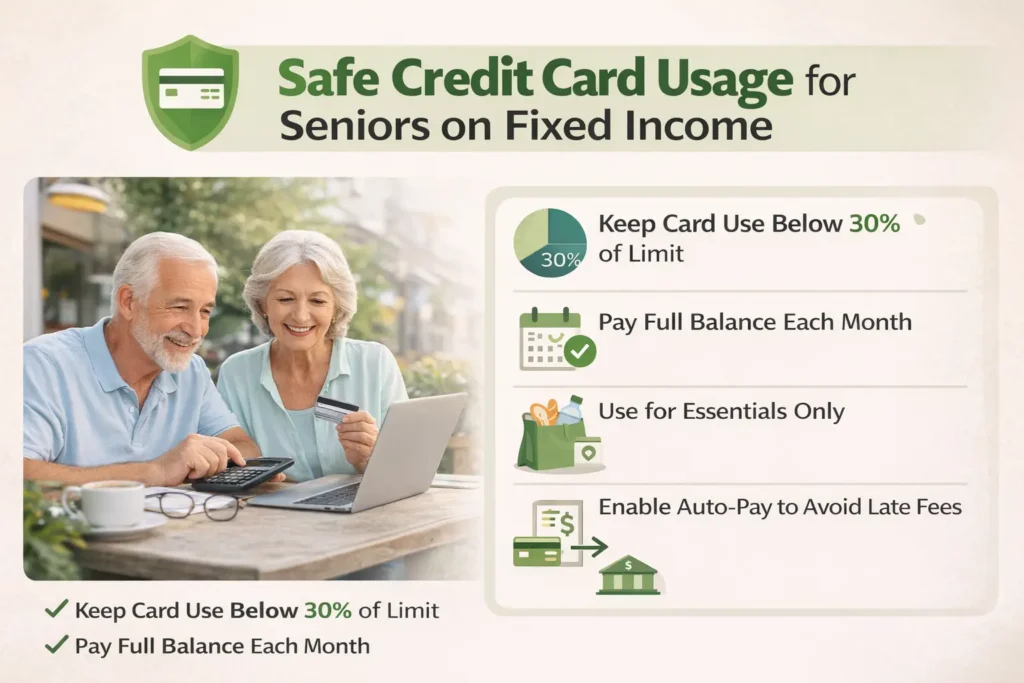
How to Use a Credit Card Safely on a Fixed Income
Structure is everything.
1️⃣ Keep Utilization Below 30%
If your limit is $500, keep balance under $150.
2️⃣ Pay in Full Monthly
Avoid interest whenever possible.
3️⃣ Use for Predictable Expenses
Groceries, utilities, subscriptions — not impulse purchases.
4️⃣ Set Autopay
Automatic payments protect against accidental late fees.
Over 6–12 months, responsible use can meaningfully improve credit stability.
When a Secured Card Might Be a Better Option
If:
- Your score is below 620
- You’ve had recent denials
- You need structured rebuilding
A secured card may be safer.
Specifically, small-deposit options starting at $200 create low-risk entry points. Learn more in our guide to $200 secured cards for seniors.
Secured cards are tools — not permanent solutions.
How Long Does It Take to Improve Credit After 60?
Credit rebuilding does not have an age limit.
For seniors on Social Security, structured use of the right credit card can improve scores meaningfully over time.
Here’s a realistic timeline:
0–3 Months
On-time payments begin strengthening payment history — the largest credit scoring factor.
3–6 Months
Credit utilization improvements start reflecting in score adjustments.
6–12 Months
Consistent responsible behavior may lead to:
- Score increases of 20–60 points
- Prequalification offers
- Credit limit increases
Even after retirement, credit cards for seniors on Social Security can serve as tools for maintaining financial credibility and flexibility.
Patience and consistency matter more than aggressive strategies.
Frequently Asked Questions
Can seniors get approved with only Social Security income?
Yes. Social Security qualifies as valid income.
Will applying hurt my credit score?
A single application may cause a small, temporary dip.
Should seniors avoid credit cards altogether?
Not necessarily. Used responsibly, credit cards provide fraud protection and help maintain active credit history.
What credit score is needed?
Most unsecured cards require 620+. Secured cards accept lower scores.
Strategic Conclusion
Living on Social Security requires precision.
The best credit cards for seniors are not the flashiest — they are the most predictable. No annual fees. Clear terms. Controlled risk.
If your credit is stable, a simple no-fee cash back card may work.
If rebuilding is needed, secured options provide structure.
Retirement is about preserving stability.
Choose credit tools that support that goal — not complicate it.